Recovery Economics
The CFO Filter: How Finance Decides Whether a Recovery Program Lives
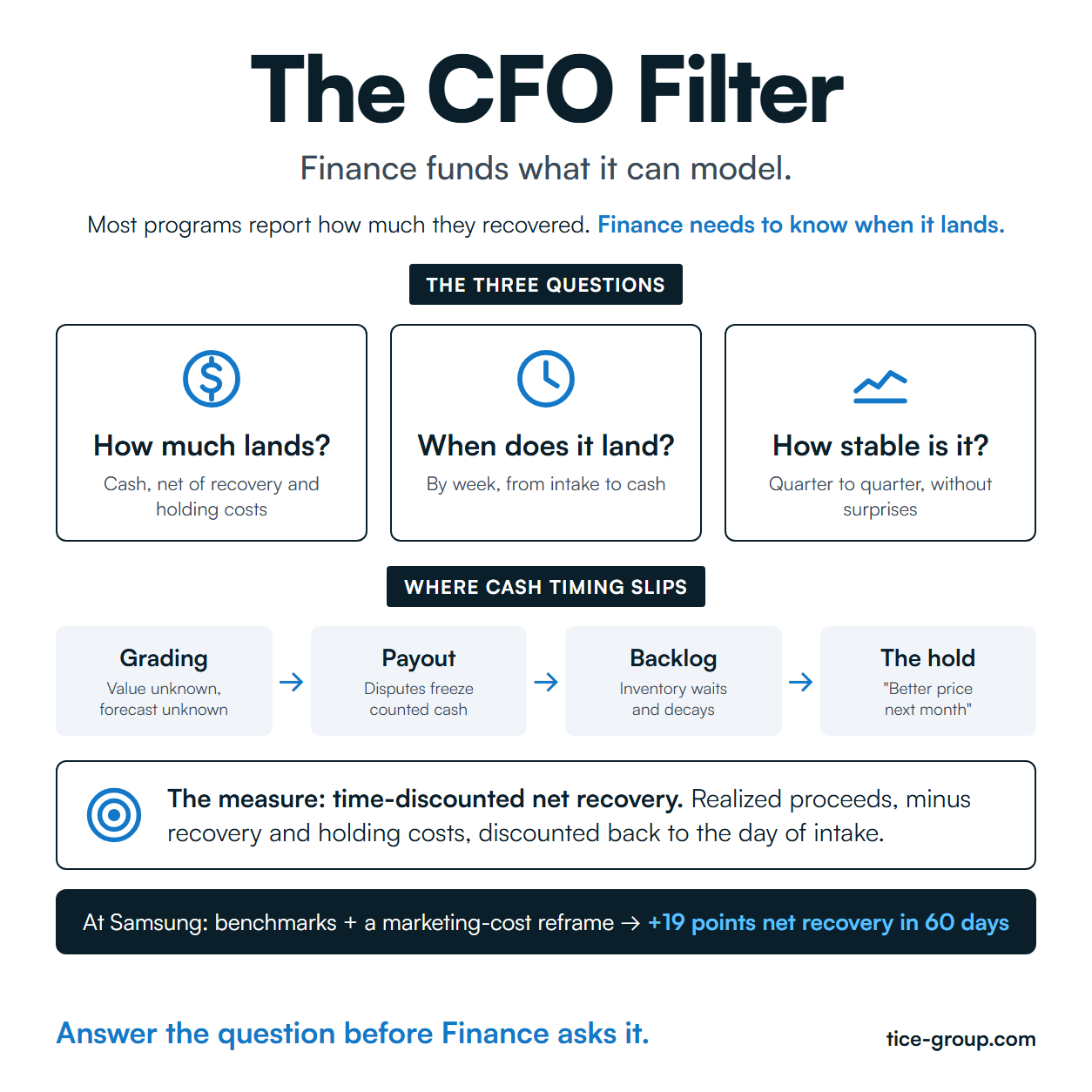
When Finance kills a trade-in, returns or recovery program, it's rarely because it doubts the money is there: it's because it can't model it. A CFO can plan around a low margin, and around a long payback. What they can't plan around is cash that arrives in different amounts at different times for reasons nobody on the program can explain in advance. And in most recovery programs, that is exactly how the cash behaves.
I spent years on the program side of that conversation. As GM of Samsung's certified pre-owned and trade-in programs, I walked our numbers into the CFO's office every month and answered for them. And the one thing I kept repeating to my team was that Finance was not the enemy: they had a tough job to do, and we'd all be better off walking in with an appreciation for it. (It's also, incidentally, how I ended up as Head of Finance for Samsung's retail operations, largely thanks to the relationship I'd built with the Korean finance team.) What follows is the filter every recovery program has to pass, seen from both chairs.
What does a CFO need to see before funding a recovery program?
A CFO's evaluation of a recovery program usually comes down to three questions: how much cash actually lands, when it lands, and how stable it is over time. Recovery rates, circularity and upside are all inputs. If the program can't answer those three in Finance's own terms, the rest of the pitch rarely gets a hearing.
I sat in a review once where a recycling initiative was pitched as "green leadership." The CFO asked one question: when does the cash hit, and how stable is it? Nobody had an answer, and the meeting ended there. The CFO wasn't being difficult, by the way: their job is to make sure cash arrives when the forecast says it will, and "green leadership" answers a question they never asked. (I've written separately about why the circularity pitch struggles with buyers too: Don't Sell Circularity. Sell Control.)
Why does Finance care more about stability than margin?
Because variance breaks the forecast, and the forecast is the job. A program that reliably returns a modest number is easy to plan around. One that swings from quarter to quarter on timing, grading disputes and somebody's feel for the market is not, even if it earns more on average. The spreadsheet hates variance more than it hates low margin.
The cost also travels beyond the program. Volatile cash makes the company's own numbers harder to hit, lenders tend to price volatility into the cost of borrowing, and acquirers often discount earnings that depend on one person's timing or luck. A program that can't be forecast sits outside the CFO's model, which means it sits outside the company's center of gravity, and when a bad quarter arrives, programs in that position are usually the first ones cut.
Why do so many recovery programs fail the CFO's three questions?
Mostly because of time. Recovery programs tend to report how much they recovered and leave out when the cash arrived. Timing slips at a handful of predictable places in the operation, and every slip moves cash out of the quarter it was forecast in. To Finance, one slip is a miss; a program that slips without warning is one they can no longer forecast at all.
Most recovery programs, however well pitched, run through the same four places where cash timing slips:
- Grading. A device or return sits unassessed, so nobody knows what it's worth yet, so nobody can forecast what it will sell for.
- Payout and settlement. Disputes between partners over condition or price freeze cash that was already counted.
- Resale backlog. Inventory waits on a channel, a buyer or a lot size, and it loses value while it waits.
- The hold. Someone decides the market will be better next month. Sometimes it is (which is exactly why the habit survives), but most of the time it isn't, and even when it is, the gain lands in a quarter nobody forecast it for.
The hold is the expensive one, because in a review it looks like discipline. I've written the operator's version of that story, where a team hit every recovery-rate target while the CFO said the program was losing money: The Recovery Half Your Dashboard Doesn't Show.
What is time-discounted net recovery?
Time-discounted net recovery is the cash a recovered asset actually returns once you account for when it returns it: realized resale proceeds, minus recovery and holding costs, discounted back to the day of intake at your cost of capital. It puts time on the page, which is why it matches how Finance already thinks.
Price is visible. Time isn't. And time is the leak that never shows up on the dashboard until it has already eaten the margin.
The mechanics fit on a napkin. In mobility, a reasonable rule of thumb is that used inventory loses about 1% of its value a week: closer to 2% near a new model launch, closer to half a percent two years in. It isn't a smooth curve. Prices bounce before a major release, COVID was utter chaos, and 2026 has actually pushed used prices up, with the chip shortage squeezing supply (that won't last forever, and the 1% a week will be back). But over any long stretch, the direction holds.
So take a $300 device and hold it for six weeks:
- Market value drifts down to roughly $282.
- Storage, security and insurance take the net under $280.
- Capital isn't free either. At a 12% annual cost of capital, six weeks of holding costs roughly another 1.5%.
To come out even with simply selling today at $300, you'd need to sell six weeks from now for about $304.50, and that's before storage. Against a market that will be paying around $282 by then, that's roughly 8% above market, closer to 9% once storage is counted. Those gaps do open up sometimes, and a few firms specialize in chasing them, the way traders try to time the stock market. Very few beat it for long.
Speed matters for a second reason, too: it answers the CFO's "when" question almost by itself, because less time between intake and cash means less room for the forecast to drift. (The capital-turns side of the same math is in The Recovery Half Your Dashboard Doesn't Show.)
What does it look like when a recovery program gets inside Finance's model?
It looks like finance: numbers measured against the market rather than against the program's own opinion, framed in terms Finance already plans against. At that point the CFO stops treating the program as a story and starts treating it as a lever they can plan around.
The Samsung trade-in launch is the version I lived from the inside, and it failed the filter before it passed it. When we launched the program (the world's first OEM-led mobility trade-in), the offer worked a little too well, and devices from every manufacturer flooded back. A phone maker isn't built for inbound logistics, and Finance had a real constraint here that I could empathize with: other brands' used phones sitting on the books at month close was a non-starter. So the rule became zero inventory at month close, and we hit it every month. We resold fast rather than well, the recovery values were low, and the dashboards were spotless. Speed alone wasn't the answer, as it turned out: we were clearing fast but pricing blind, and time-discounted net recovery rewards speed at market value, never speed at any price.
What changed it was giving Finance a model they could trust, in two moves. First, we moved monetization onto a professional auction marketplace, which gave us real market benchmarks instead of our own opinion of what a device was worth. Second, we reframed trade-in for Finance as a marketing cost, compared against what the company already spent on buy-one-get-one promotions, rather than as an inventory problem. That reframe is what let Finance change the goal itself: once trade-in sat next to promotional spend, the target moved from clearing inventory by month close to maximizing net recovery value, and the auction benchmarks told us what maximum looked like. The operation didn't get cleverer overnight, but the program started speaking Finance's language, and Finance became a partner instead of a constraint. Net recovery rose 19 points within 60 days, with no added headcount.
How do you get your recovery program inside Finance's model?
Answer the CFO's three questions before they ask them. Five moves, before the next budget conversation, each aimed at one of those questions:
- Put a clock on the dashboard (when). Days from intake to cash, or days of inventory, next to the recovery rate. Start with whichever one your team can actually produce.
- Forecast cash by week, from intake to sale (when, and how stable). Even a rough curve beats a quarterly total, because it shows Finance where the timing risk sits.
- Benchmark against the market (how much). An external price reference (an auction channel, a scraped competitor offer, a partner quote) turns "we think it's worth X" into a number Finance can check.
- Name the holds (how stable). Any inventory held for a better price gets an owner, a date and a cost of waiting. Holding can still be right sometimes; it just stops being free.
- Find the budget line Finance already manages (all three). At Samsung it was marketing spend. For a retailer it might be shrink, markdowns or returns reserves. The program is easier to fund when it sits next to a number the CFO already plans against.
None of this is glamorous, granted. But it turns the program from something Finance has to tolerate into something Finance can plan around. Finance was never the enemy: walk in with their question (how much do we recover, and when does it land?) already answered, and they tend to become the program's best ally.
Closing the delta is the work.
See where yours stands.
A 4-minute diagnostic shows where your recovery process leaks value. Ready to find out?