The first time a clerk at a big-three carrier store volunteered, unprompted, that he owned the trade-in program, I almost laughed. I shouldn't have.
He was not exactly wrong. He owned a piece of it: the moment when a customer hands him an iPhone, he taps a few screens, and a number lands on the receipt. From his side of the counter, that IS the program. It is the only part he can see, the only part that touches his bonus, and the only part anyone in his chain of command has ever asked him about.
The problem is that everyone else in the chain says the same thing.
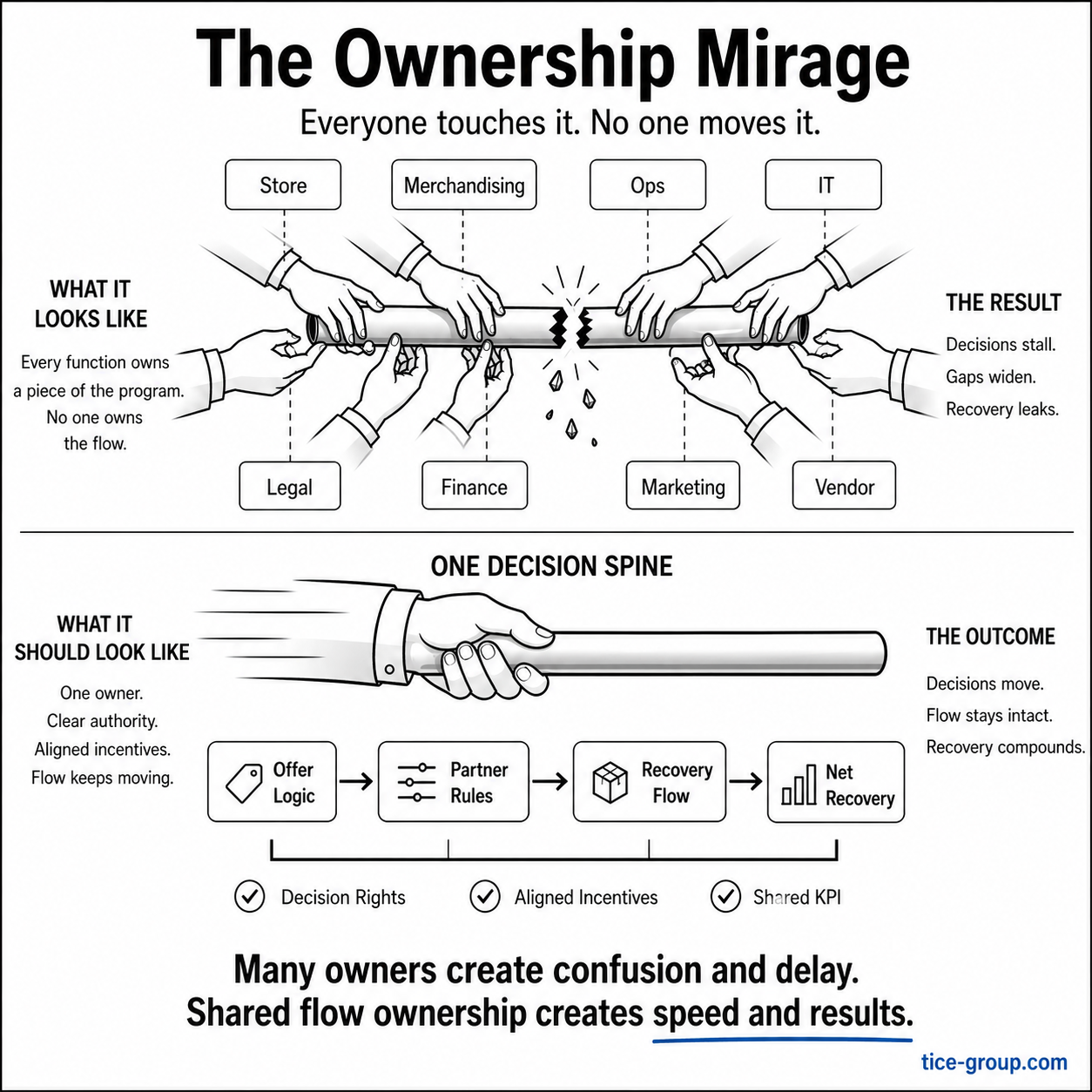
Walk the program upward and the pattern repeats:
- The store manager owns it (her store's per-shift trade rate).
- The regional ops lead owns it (his volume forecast).
- The VP of Merchandising owns it (the device economics, the offer table, the partner contract).
- The Ops director at HQ owns it (the flow rate, the dwell time, the warehouse throughput).
- The IT lead owns it (the API to the grading partner, the integration uptime).
- Marketing owns it (the campaign that drove foot traffic).
- Legal owns it (the contract with the recommerce processor).
- Finance owns it (the P&L line, the capital tied up in inventory, the writedown reserve).
And somewhere up top, a senior exec signs the budget and answers to the CFO when the line moves the wrong way.
Eight to ten owners, depending on the org. All sincere. None lying.
This is the Ownership Mirage. Every level of the org chart can name a person who "owns" the program. None of those people, individually, can move it.
What it looked like from the inside
I learned this from the inside at Samsung, where my team built the first mobility OEM trade-in program in the world. We owned the loop end-to-end: SKU eligibility, the pricing model, the partner contracts with various carriers, retailers, and recommerce partners, and the reverse logistics chain that took a returned device from a customer's hand all the way through intake, testing, refurbishment, and monetization. Whatever channel a device came in through, our team owned the loop.
The IT and e-commerce team in Seattle, meanwhile, owned the customer-facing trade-in flow on samsung.com. They built it well, and it was a real piece of engineering. But for two or three years, that team behaved as though they owned trade-in. To them, our piece was negligible. They could not see it from where they sat. The only slice of the program they could see was their slice, and they sincerely believed it WAS the program.
Why nobody can move it: decision rights
The first reason is decision rights. When ownership is sliced this thin, no single person has the authority to change anything that matters. The clerk can only change his pitch. The store manager can only change the staffing rotation. The Ops director can rewrite the warehouse SOP, but only inside the contract IT negotiated, with a partner Legal locked in two years ago, against an offer table Merchandising won't touch until the next pricing committee meets. Every meaningful lever sits behind a permission gate held by someone who isn't accountable for the outcome that lever moves.
So when the program drifts (and trade-in programs usually drift inside the first six to twelve months of going live), every "owner" honestly inspects their slice and reports back: mine is fine. The drift is happening in the seams between them, in the territory nobody is responsible for. I have written before about what breaks at the handoff layer between two roles; the Ownership Mirage is the same problem one level up.
The second reason: everyone means something different
The second reason, layered underneath, is definitional. "Trade-in" means a different thing to each of those owners: a counter transaction to the clerk, a weekly attach rate to the store manager, a cost per unit to Ops, an uptime metric to IT, and a quarterly recovery rate against book value to Finance. Each definition is correct in its own frame. Each is also a different KPI on a different timeline with a different failure mode. When IT's number is healthy, Finance's might be drifting eight basis points a month and nobody upstream can see it. Six people in a room saying "the trade-in program needs to improve" are picturing six different problems and measuring success against six different numbers.
The question that cuts through the mirage
There is a question I started asking, somewhere along the way, that cuts through the mirage faster than any org chart review:
If the program misses its annual recovery target by 30%, whose bonus moves?
The silence is the diagnostic. Most of the time, nobody's. Each owner is comped on their slice, not on net recovery. They are responsible for their slice, which is a different thing from being accountable for the program. And even when an owner's comp does have program exposure, the program is one of six or eight items in their portfolio: a 30% miss might shift their personal comp by less than a point. The program drifts down the priority list because no one has enough skin in it to redirect their week.
Why appointing a single owner usually backfires
The instinct, when an executive finally sees the mirage, is to fix it by appointing a single owner. From now on, Trade-In has a name on it.
This sometimes works. More often, it produces a different failure mode: the new owner gets the accountability without the authority. They own the outcome but cannot change the offer table, cannot renegotiate the recommerce contract, cannot shift the IT roadmap, cannot move the comp structure of the field. They become the person whose job it is to absorb the friction generated by every other owner's slice.
This is the old matrix organization. You are responsible for the outcome. You don't really control the people whose actions decide it. They do not report to you, they have their own priorities, and your problem is not high on their list. Been there, done that. Not fun.
That version of the fix burns out good operators. It is not a failure of the operator. It is a failure of the design.
Some programs do run distributed ownership well: a real RACI, a tight-cadence steering committee, and a comp plan that puts net recovery in everyone's pay can hold the seams. More often, the partnership becomes the alibi: nobody owns the outcome, and "we are jointly accountable" is the line on the deck when nothing has moved in two quarters.
What real ownership requires
When the partnership model isn't holding, real ownership of an end-to-end recovery program needs three things, and they have to travel together:
1. Decision rights. The owner can actually change the things that drive the outcome: the offer table, the partner mix, the SOP, the IT priorities, the comp structure of the field. Not "consult on" or "raise to a committee." Change.
2. KPIs that move with the program. The owner's compensation, and the compensation of every layer below them, has at least a meaningful slice tied to the outcome the program is meant to produce. If the program exists to drive net recovery, net recovery has to show up in the comp plan of the people whose actions affect it. The clerk's bonus needs at least a piece tied to recovery quality, not just unit count. (This is operationally hard to design and politically harder to implement. It is also not optional.)
3. One throat to choke at the top. Ask any senior leader who owns the program. If the answer is a name, the program has a chance. If the answer is "well, it's a partnership across multiple functions," the program is already back in the mirage.
This is the gap between owning a sliver of trade-in and owning the program. Most people I meet who tell me they "do trade-in" or "lead our trade-in" are sincerely owning a sliver: the clerk in the store, the category manager at HQ, the recommerce vendor on the other side of the contract. Each of them is a real expert in their slice, and not one of them is in a position to make the program work end-to-end. End-to-end is a different job. Most orgs are built to run slivers, not loops.
In most orgs, the answer to that bonus question is "nobody, really." The org chart says otherwise. That is the mirage. The clerk at the counter is doing his job. The eight to ten people above him are doing theirs. None of them is running the program.
Closing the delta is the work.
See where yours stands.
A 4-minute diagnostic shows where your recovery process leaks value. Ready to find out?