Industry Trends
ITAD Has Always Been Bigger. The Mobile Playbook Is Moving In.
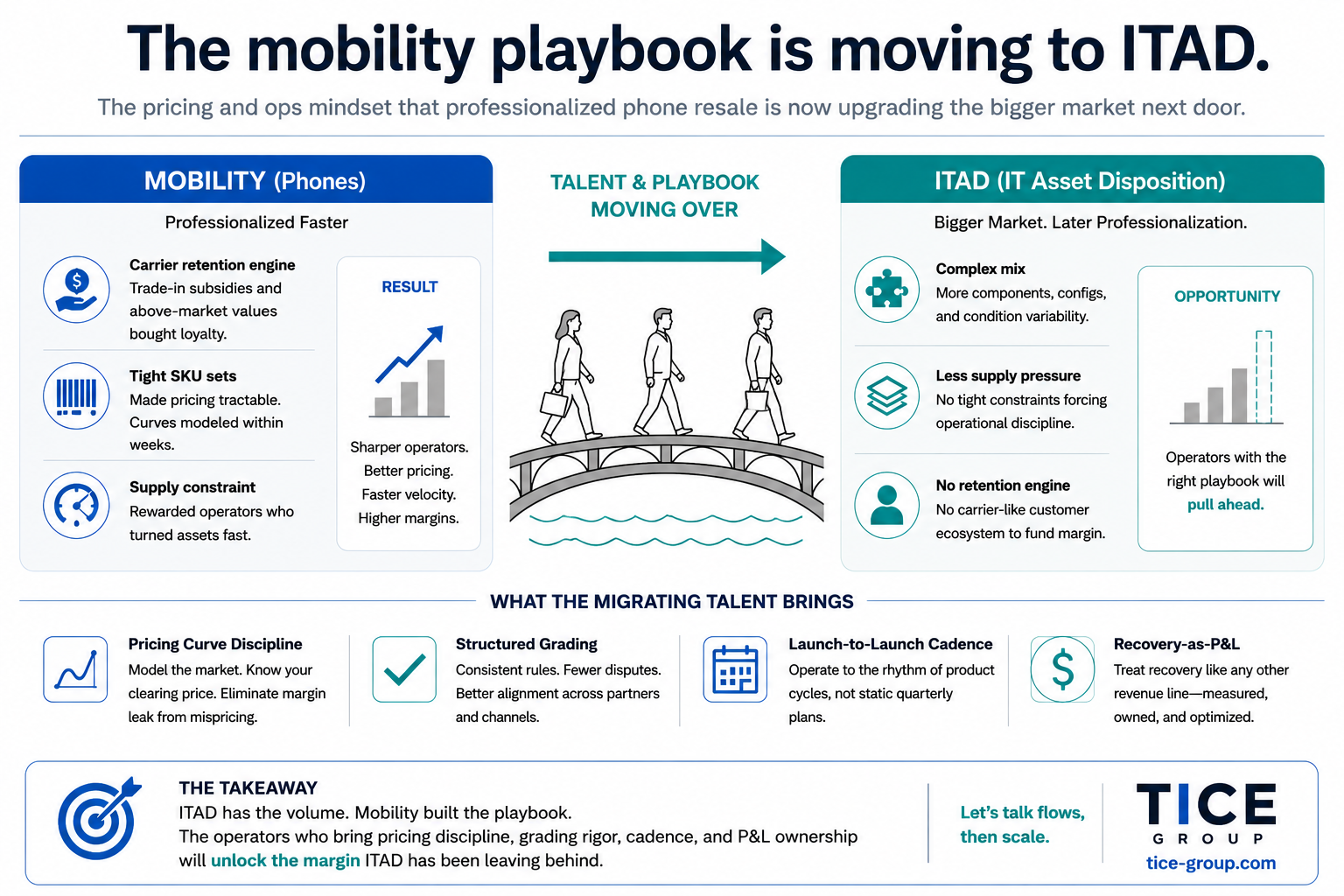
Mobile resale has always been the smaller side of device recovery. It professionalized faster anyway, and the talent flow is now reversing toward ITAD. The operators who built the phone side's discipline are showing up at ITAD shops (IT asset disposition, the corporate-fleet side of recovery), and they're carrying a playbook with them.
I spent the better part of a decade inside that industrialization, building recovery and trade-in programs at Samsung and SquareTrade. A senior peer in ITAD recently put the share of his current contacts coming over from the phone industry at roughly a third, a share that would have been a rounding error not long ago. I now run TICE, which builds recovery programs for enterprises, so I have a stake in where this goes, but the migration is real regardless of who's narrating it. The short version: ITAD is inheriting a decade of operational discipline as a talent transfer, and the shops that recognize that for what it is will pull away from the ones that don't.
Three pressures the phone side had and ITAD didn't
Three structural pressures explain the asymmetry. The phone side had them, ITAD didn't, and they forced operators to get sharper on pricing, grading, launch-to-launch cadence, and asset velocity whether they wanted to or not.
Carriers buying customer retention through trade-in subsidies (three-year installment plans, above-market trade-in values, the works). Tight SKU sets that made pricing tractable, where you can have a clearing curve modeled within weeks of a launch instead of months. And a persistent supply constraint that rewarded any operator who could turn assets fast, because anything sitting in a warehouse was a meaningful share of available inventory.
ITAD has had none of those. Pricing has always been harder (more components, more variation, more bespoke configurations), supply has been less constrained, and there's never been an analog to the carrier retention engine: even the OEM trade-in programs that exist on the laptop side (Lenovo, HP) don't have the customer-ecosystem lever that lets large carriers eat margin to keep an account.
So the phone side industrialized faster while ITAD stayed informal longer. The core ITAD business was profitable enough that nobody had to chase pennies the way the phone side did, and a sector that isn't under that kind of pressure tends to optimize later, not never. That's the moment we're in now.
What the talent brings with them
What the migrating talent brings with them is four operational disciplines ITAD has historically treated as adjacent rather than core: pricing curve discipline, structured grading, launch-to-launch cadence, and recovery-as-P&L. I lived inside all four for the better part of a decade. I'll walk through pricing curve discipline in the most detail, because it's probably the clearest illustration of how wide the gap actually runs.
When I started Samsung's trade-in program, I relied on pricing curves from a wholesale partner whose data covered the market I needed. The curves were good: my recollection is they landed within a few points across the categories I cared about. The operator instinct on the phone side was to push past that anyway, because at scale even a few points of miss is real margin walking out the door. So I built my own curves on top of theirs, leveraging the Samsung-specific SKU view I had as the OEM: a flagship model isn't one curve, it's multiple (regular, Plus, Ultra, storage tiers), and each of those decays slightly differently against trade-in timing, color mix, and channel. Within a few cycles I'd tightened it to the point where pricing variance stopped being where I was losing money.
Then I layered a champion-challenger model on top of that. A vendor processor (different from the wholesale partner) would grade devices and offer to pre-sell on my behalf, giving me a price and 24 to 48 hours to either accept or sell elsewhere. The point wasn't outsourcing the resale decision: it was running their offer against my own curves on every cycle, every SKU. Where they were competitive, I sold to them. Where my curve said I could do better, I sent it to the wholesale channel. Keeping a live alternative on the table is what kept everyone's pricing honest, mine included. The structure refined my pricing model and lifted net recovery at the same time. Granted, this kind of weekly-or-faster price refinement isn't unheard of among the large phone-side players, but ITAD companies just don't do this yet. The volume isn't there for any single SKU, the pricing curves are harder to build, and the discipline has never been a competitive necessity because ITAD's customers haven't been demanding it.
The same gap shows up across the other three disciplines, just less visibly than it does in pricing. Structured grading: phone-side operators expect consistent grade-to-cosmetic mappings backed by image-based QA, rather than grading that lives in an experienced inspector's head. Launch-to-launch cadence: every new model is a planning event (pricing forecast, channel mix, inbound flow shaping) run on a calendar instead of as a reactive scramble. I lived this one on the certified pre-owned side, where each launch reset the entire pricing and supply picture at once and you either planned for it or got run over by it. Recovery-as-P&L: phone-side recovery teams report margin contribution, not disposal cost, and if you're closing the loop without a clear lift to the unit economics, you're not done. Inside an ITAD shop those expectations can read as a critique; really they're just the operating manual the phone side already wrote.
Where the playbook breaks in ITAD
Once that talent crosses over, it hits the part the phone side never had to learn. The first hurdle is SKU explosion: an ITAD shop deals with far more configuration variety than any mobile operator ever did, with more vendors, more refresh generations, and more memory and CPU tiers active at the same time. The pricing-curve discipline that worked on a clean flagship lineup doesn't translate to that. Then come the bespoke enterprise configurations: a corporate laptop fleet isn't priced like a consumer product, because the residual moves with custom imaging, lease terms, original purchase channel, and a stack of data-destruction certificates that don't exist on the mobile side.
And data security works differently here: in mobile the wipe is one step in the workflow; in ITAD it's the gate everything else waits behind.
I'm describing operating economics there, not the compliance bar. The practical effect is that margin work can't begin until certified data destruction is done, never alongside it, which changes how an operator has to sequence everything downstream.
None of this is a reason the migration fails, to be clear. It's the part of the playbook that has to get rewritten on the ITAD side, by the same people bringing it across. The ones who succeed will probably end up looking less like ex-mobile operators and more like a new operator archetype.
Mobile's discipline, ITAD's complexity, neither sector's blind spots.
A way to size the gap
If you want the structured version, Peter Evans and I published a white paper, Scaling the Circular Economy for Electronics, that lays out the path: Pilot, Integrate, Optimize. A 4-month Pilot picks one business unit or asset category, measures current recovery, sets benchmarks, validates that the disposition flow can actually be tracked at the asset level. A 14-month Integrate phase scales across regions and asset classes, layers in value-added services (repair, refurbishment, redeployment, buyback), and picks the platform engagement model that fits. The Optimize phase, beyond 18 months, is where circularity stops being an initiative and becomes operating leverage. It isn't a magic flip but a deliberate sequence, and the sequence works because it forces the kind of discipline the phone side has been running on for years.
The diagnostic at the front of that sequence is the Circularity Delta, a term Peter and I coined for the gap between what an organization spends on hardware in a year and what comes back as recovered value, expressed as a percentage. In the white paper we put typical ad-hoc recovery at 10 to 15% of original spend, which leaves an 85 to 90% delta. Operators running purpose-built recovery (the kind the phone side has been doing for a decade) lift recovery toward 30%, still not great but roughly double or triple the norm. The math isn't flattering, which is the point: the corporations on the other side of the disposition chain can't manage a delta they haven't sized, and once they do, the operators they buy from are going to be measured against that range.
The takeaway if you run an ITAD shop
The mobile-trained talent walking in your door is carrying the operating manual the phone side wrote over the last decade. You can learn it on the inside (hire from that pool, listen to what they want to change, treat those changes as a playbook you're getting for free, not as a critique of how you got here) or you can wait for your comp set to learn it and catch up under pressure. This is the part I find genuinely exciting: most sectors don't get a free decade of imported playbook arriving as fresh hires, but ITAD does, right now. From what I've seen, the shops that take it seriously can move customer recovery toward the high 20s and tighten pricing variance to something close to what the phone side already runs, within a few refresh cycles. The ones that treat it as noise will keep their customers stuck in the low teens while their competition pulls those customers away.
The Circularity Delta isn't your number to size. It's your customers'. Your work is to become the operator who closes it for them. The cheapest first move this quarter is to pick one of those four disciplines (pricing curve, structured grading, launch-to-launch cadence, or recovery-as-P&L), figure out where you're weakest, and get visibly better at it before your competition does.
A note on the numbers: the 10 to 30% range comes from that white paper and from what I've separately modeled at TICE. Both are mine, so read it as one operator's estimate, not two independent sources lining up. It's the range I keep seeing, which is the only reason it's worth putting in front of you.
Closing the delta is the work.
See where yours stands.
A 4-minute diagnostic shows where your recovery process leaks value. Ready to find out?