Recovery Economics
Nobody Invoiced This Discount. It Still Cost Us Millions.

Nobody ever sent us an invoice for it, but one discount cost us millions of dollars.
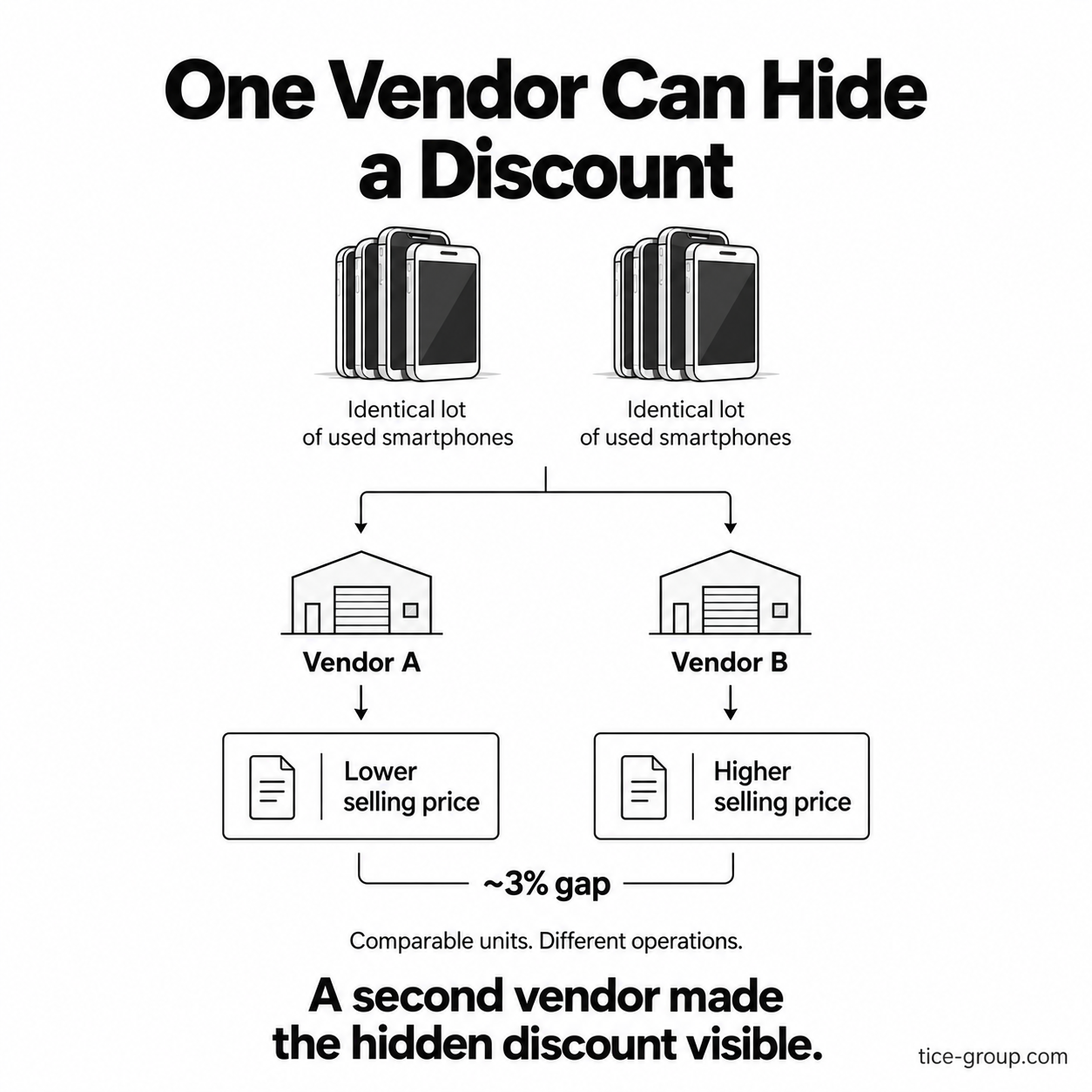
At Samsung, one of our two processing vendors started shipping late. Nothing dramatic (no lost lots, no inventory problems), just a pick, pack and ship cycle that slowed a little more every month while their management was looking elsewhere. By the end, their inventory was selling about 3% cheaper than our other vendor's, on comparable units.
I told that story from the vendor's side in EG#20. This time I want the price side. Roughly 1% of the gap was phones aging while they waited to ship (the decay math in The CFO Filter). The other 2% was buyers protecting themselves. This piece is about that 2%, because it is the part a recovery scorecard can easily miss (and the part no vendor will ever put on a slide).
Think about it from the buyer's chair for a second. A buyer bidding on your lots can't audit your warehouse. All they have is your track record: did the lots show up when promised, and did the condition grades hold up when they opened the boxes? When one of those slips, a careful buyer assumes the other might slip too, and takes a bit extra off the bid to cover the risk. That extra is a margin of safety, and it pays for what the buyer suspects, not for anything wrong with the units. Which is why it never arrives as an invoice: it arrives as a lower price on everything that vendor ships, clean lots included.
A buyer's margin of safety also doesn't show up in any vendor's performance report, so the vendor's own reporting was no help. We only saw it because our other vendor was selling comparable units at the going market price, which gave us a second price to hold the first one against. Without it, the 3% gap would have looked like "the market", and we would probably have shrugged and moved on.
What OEMs miss
Which brings me to what OEMs (the phone makers themselves) tend to miss about recovery. A trade-in program usually gets judged in units: how many devices came back, and how many upgrades the trade-in credit pulled forward. Every OEM weighs this a little differently, but units are usually the headline, and that is fair: it is the number the program exists to move. But the margin on each of those units gets decided after the count, and it leaks in two places that rarely show up in the review where the program gets judged.
Leak #1: Which step you sell at
Monetization is a sequence of decisions, not a single sale, and I formalized the sequence years ago: start with a take-all buyer (one buyer, every unit, one price, even if ugly), move to an auction marketplace, then tune those auctions (lot sizes, timing, what information you share with buyers). Further out, add direct channels for the high grades, look at refurbishment for the low grades, and sell abroad where the prices are better. Then go back and tune the auctions again, because the optimization never really ends. Each step is its own call, and a program parked on step one still reports every unit as recovered.
At Samsung, we climbed it in four moves. We did our own reselling first, then built our own de facto auction site, then outsourced the auction, then split the auction volume: 70-80% to an established partner (the champion), the rest to a smaller challenger, which won more of the business as it improved. We never got to direct-to-consumer. Plenty of partners were happy to try, but none of them already did it at scale, which meant they would have learned on our products, on our dime. I refused to pay for that, and I ran out of time to find the right partner before I changed roles.
Leak #2: The buyer's margin of safety
This one is nastier, because a better channel rarely fixes it on its own: buyers tend to price your operation, not only your inventory. We never did get it out of that vendor's lots. What worked in the end was shifting volume, a little at a time, to the operation buyers already trusted.
The two questions
So the useful question for an OEM is less "who buys our trade-ins?" and more two questions: which step of the sequence are we actually standing on, and what do our buyers think our operation is worth? The second one is harder, since buyers rarely tell you they are discounting you. A second price on comparable units (another vendor, or even a single test lot) will usually show it.
Good looks like this: buyers bid your lots at the going market price, with no margin of safety, because your processing and shipping have been boringly predictable for long enough that they stopped wondering what they can't see.
FAQ
What is a buyer's margin of safety in trade-in resale?
The extra a buyer takes off a bid to cover risk they can't see, such as late shipping or condition grades that may not hold. It lands as a lower price on every lot from that vendor.
How can an OEM tell if buyers are discounting its lots?
Get a second price on comparable units, from another vendor or a single test lot. Without one, the gap looks like the market.
What is the monetization sequence for trade-in devices?
Start with a take-all buyer, move to an auction marketplace, and tune the auctions. Then add direct channels for high grades, refurbishment for low grades, and international sales, and keep tuning.
Closing the delta is the work.
See where yours stands.
A 4-minute diagnostic shows where your recovery process leaks value. Ready to find out?